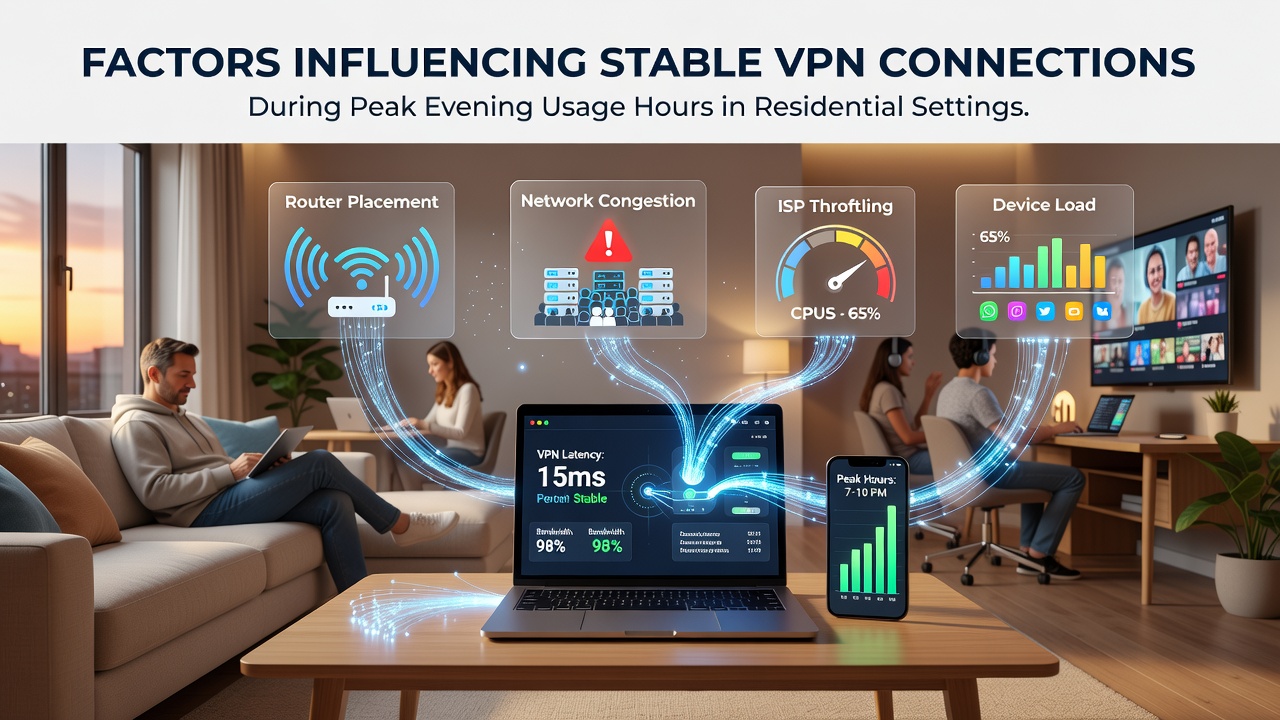
Factors Influencing Stable VPN Connections During Peak Evening Usage Hours in Residential Settings
Peak evening usage hours in residential areas typically span from 6 PM to 11 PM when households stream video content, engage in remote work sessions, and manage multiple connected devices simultaneously. These periods place significant demands on internet service provider networks and individual home setups which directly affect VPN performance. Research from network monitoring organizations shows that connection stability drops when bandwidth contention rises across shared neighborhood infrastructure.
ISP Network Congestion Patterns
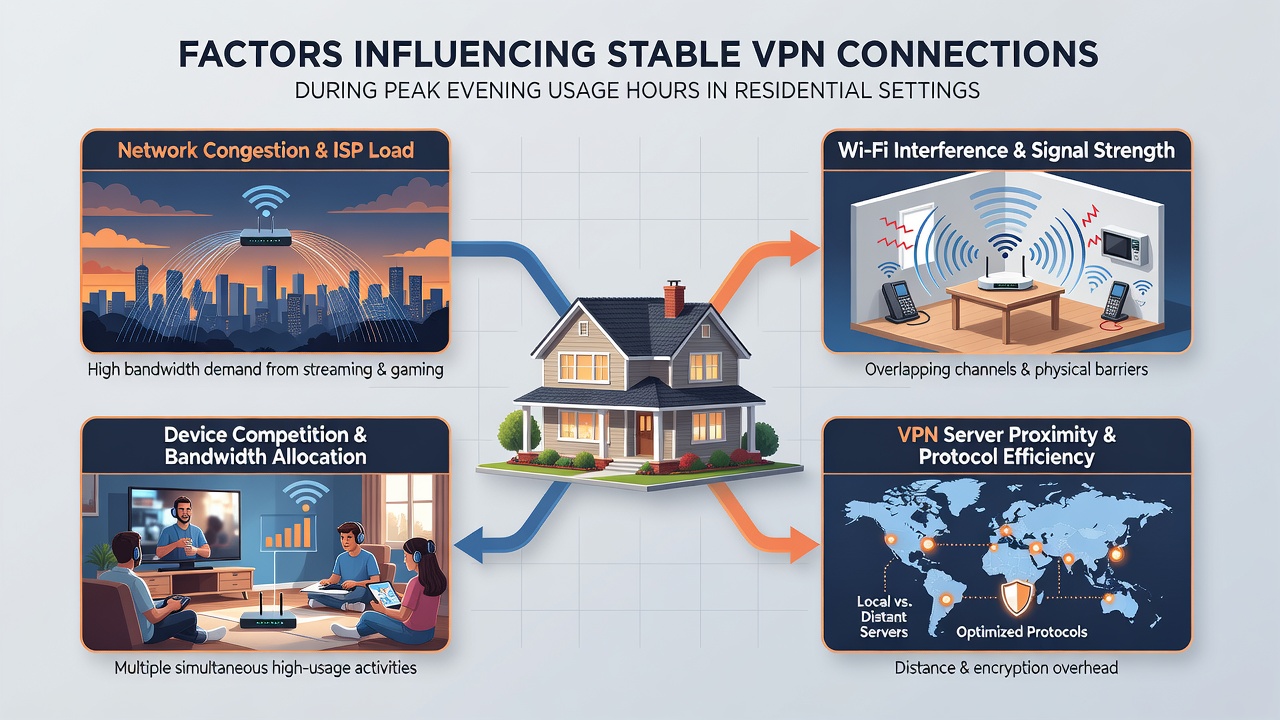
Internet service providers experience heightened traffic loads during evening hours because residential users consume large volumes of data for entertainment and productivity tasks at the same time. Data from the Canadian Radio-television and Telecommunications Commission indicates that download speeds can decrease by up to 30 percent in urban neighborhoods between 7 PM and 10 PM on weekdays. VPN connections suffer additional overhead from encryption processes which compounds the effects of this congestion. Observers note that users in densely populated areas report more frequent disconnections when local exchange points reach capacity limits.
Throttling practices by some providers further influence stability because certain traffic types receive lower priority during high-demand windows. Residential connections often share bandwidth among hundreds of households on the same node and VPN traffic gets treated similarly to other encrypted flows. Studies released in July 2026 from regional broadband authorities confirm that nodes serving over 500 homes experience the sharpest performance declines after 8 PM.
Router Hardware and Firmware Limitations
Home routers process VPN traffic through their CPU which becomes a bottleneck when handling encryption and decryption tasks alongside regular routing duties. Older models with single-core processors struggle to maintain consistent speeds above 50 Mbps when VPN protocols run at full strength. Firmware updates released by manufacturers address buffer management issues yet many residential devices remain on outdated versions that cannot prioritize VPN packets effectively during peak times.
Those who maintain current firmware observe better connection persistence because improved algorithms handle packet loss recovery more efficiently. Multi-device households compound the problem since routers must manage simultaneous connections from smartphones, laptops, and smart home equipment while maintaining the VPN tunnel. Network analysts report that routers with at least 1 GB of RAM sustain stable VPN sessions more reliably when evening traffic spikes occur.
VPN Server Capacity and Geographic Distribution
VPN providers allocate server resources across regions and evening hours bring increased demand from users in similar time zones. Servers located near major residential population centers fill up faster because latency-sensitive applications compete for available slots. A 2026 industry report from European network research groups found that servers operating above 80 percent capacity show measurable increases in packet latency and occasional tunnel drops.
Users who select servers in adjacent time zones sometimes achieve more stable connections because those facilities experience lower concurrent loads during their local peak periods. Protocol choice also matters since WireGuard implementations consume fewer server resources than older OpenVPN configurations while delivering comparable encryption strength. Providers that publish real-time server load statistics enable subscribers to avoid oversubscribed endpoints during high-traffic evenings.
Wi-Fi Signal Quality and Interference Sources
Wireless signal degradation affects VPN stability when routers and client devices operate on crowded 2.4 GHz or 5 GHz bands. Neighboring networks transmit on overlapping channels during evening hours when streaming activity peaks and this interference increases retransmission rates. VPN packets that require reassembly due to lost fragments introduce delays that manifest as stuttering video or interrupted file transfers.
Mesh systems and wired backhaul connections reduce these issues by distributing load across multiple access points. Research indicates that homes using 6 GHz bands introduced with Wi-Fi 6E standards maintain more consistent VPN throughput because fewer legacy devices compete on those frequencies. Physical obstructions such as thick walls or metal appliances further attenuate signals and users who position routers centrally report fewer evening disruptions.
Device Count and Background Application Activity
Each additional connected device consumes bandwidth and processing cycles even when idle because operating systems perform background updates and synchronization tasks. Smart TVs, gaming consoles, and security cameras contribute to aggregate traffic that competes with VPN sessions. Data collected by university network laboratories shows households averaging more than 15 connected devices experience 25 percent higher VPN latency during peak evening windows compared to smaller setups.
Applications running automatic cloud backups or software updates add unpredictable bursts that strain available capacity. Those who schedule such activities outside peak hours maintain steadier VPN performance because the connection faces fewer competing flows. Quality of service settings on modern routers allow prioritization of VPN traffic yet many residential configurations leave these options disabled by default.
Conclusion
Multiple interconnected factors determine VPN connection stability during residential peak evening hours. ISP congestion, router capabilities, server loads, wireless interference, and device activity each contribute measurable effects according to data gathered by regulatory and research organizations. Households that address hardware limitations, select appropriate server locations, and manage background traffic observe more consistent performance across these demanding periods. Continued monitoring by broadband authorities and ongoing firmware improvements from equipment manufacturers provide pathways for sustained reliability as usage patterns evolve.