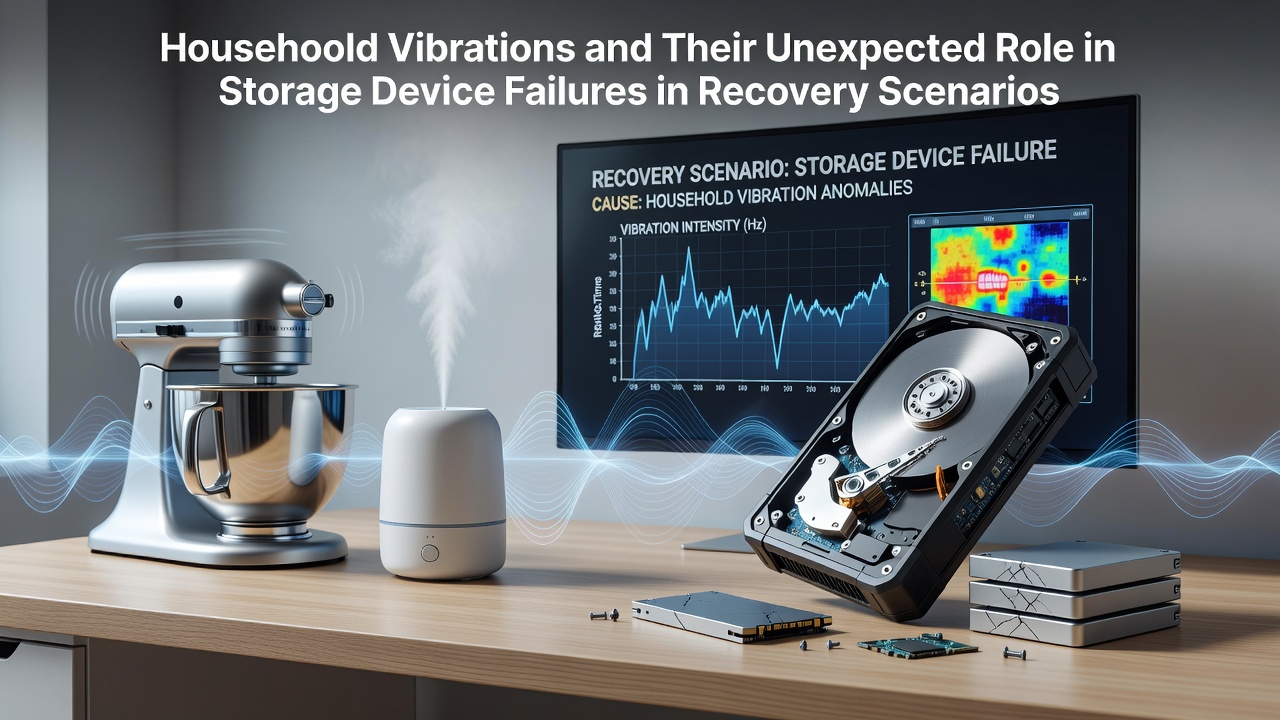
Household Vibrations and Their Unexpected Role in Storage Device Failures for Recovery Scenarios
Household vibrations travel through floors, walls, and furniture in ways that often go unnoticed until storage devices begin to fail, and data recovery specialists frequently trace mechanical damage in hard disk drives back to these everyday sources, since spinning platters and delicate read-write heads respond directly to external oscillations that exceed design tolerances.
Common Household Sources of Vibrations
Washing machines and dryers generate rhythmic shaking during spin cycles, while footsteps on wooden floors transmit low-frequency pulses that reach nearby desks or entertainment centers, and researchers at various institutions have measured these disturbances reaching amplitudes capable of disturbing hard drive operations in multi-story homes.
Traffic from nearby roads creates continuous micro-vibrations through building foundations, ceiling fans add rotational frequencies that resonate with certain furniture arrangements, and people who place computers near laundry areas or on the same surface as exercise equipment discover that cumulative exposure accelerates wear on mechanical components.
Mechanical Effects on Storage Hardware
Hard disk drives contain rapidly spinning platters and actuator arms that maintain nanometer-level precision, yet external vibrations cause the heads to deviate from their flight path and contact the disk surface, which produces scratches, bad sectors, and in severe cases head crashes that render data inaccessible without specialized recovery tools.
Solid state drives lack moving parts and therefore resist vibration damage more effectively, although extreme conditions can still affect controller chips or solder joints over extended periods, and data from multiple studies indicates that hybrid environments containing both drive types require separate handling protocols during recovery operations.
In July 2026 a technical brief released by the National Institute of Standards and Technology documented vibration thresholds at which consumer-grade hard drives exhibited increased failure rates, and the findings aligned with field reports from recovery laboratories that process devices from residential settings.
Recovery Challenges and Diagnostic Patterns
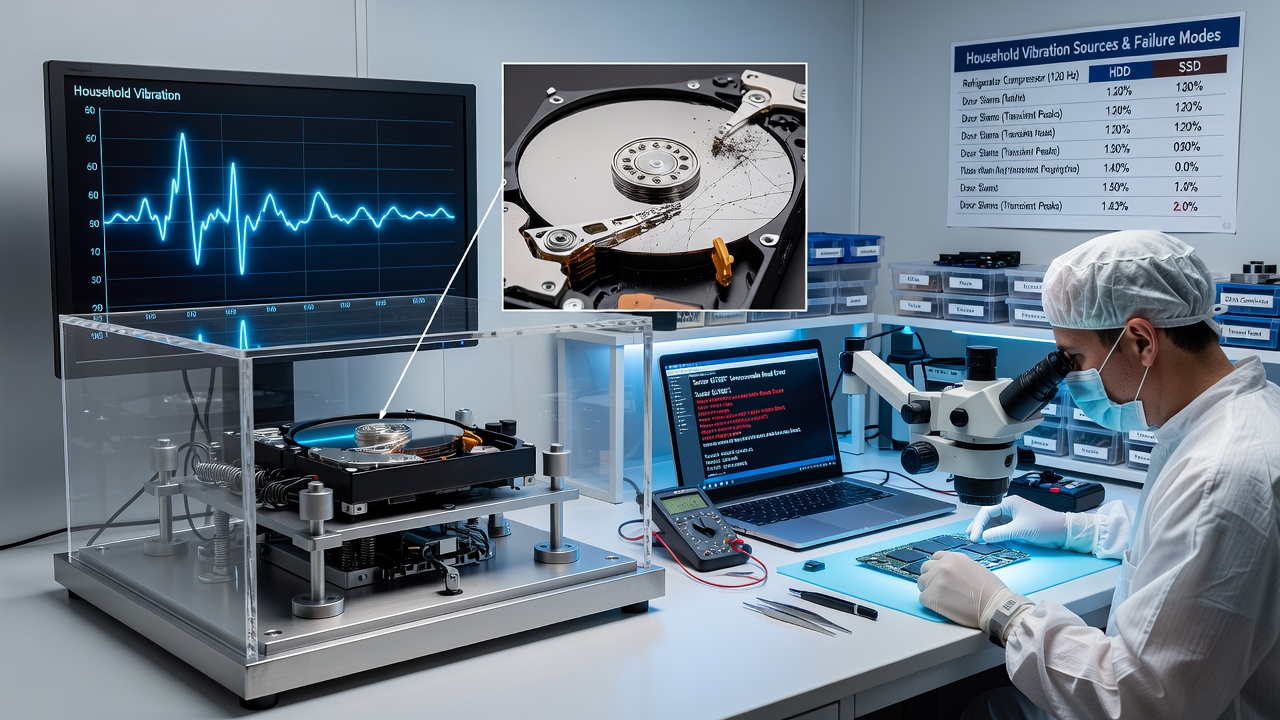
Recovery teams examine failed drives for telltale signs such as circular scratch patterns on platters or displaced head assemblies, and these indicators often point to vibration as a contributing factor rather than power surges or manufacturing defects alone, which allows technicians to adjust their approach and avoid further damage during imaging procedures.
People who attempt DIY recovery on vibration-affected drives sometimes compound the problem by operating the device in the same environment that caused the initial failure, whereas professionals transfer units to isolated benches equipped with damping materials before attempting to read remaining sectors.
Statistics compiled by industry groups show that vibration-related failures represent a measurable portion of residential cases submitted for recovery, and specialists note that early detection through unusual clicking sounds or slow access times can improve success rates when users seek professional assistance promptly.
Environmental Factors and Mitigation Data
Placement decisions influence exposure levels, since mounting drives on rubber pads or relocating equipment away from high-traffic zones reduces transmitted energy, and laboratory tests conducted by teh Australian Research Council have quantified how simple isolation techniques lower peak acceleration values reaching internal components.
Multi-device households face additional complexity when network-attached storage units share surfaces with printers or gaming consoles that produce intermittent vibrations, and observers report that scheduled maintenance windows during quieter hours help minimize cumulative stress on mechanical drives.
Monitoring tools that log drive health parameters can flag rising error rates potentially linked to vibration, giving users objective data to support decisions about relocation or replacement before total failure occurs.
Conclusion
Household vibrations interact with storage hardware in measurable ways that directly affect failure rates and subsequent recovery outcomes, and evidence from technical reports, field diagnostics, and controlled studies continues to clarify these relationships for both consumers and professionals working with residential equipment.