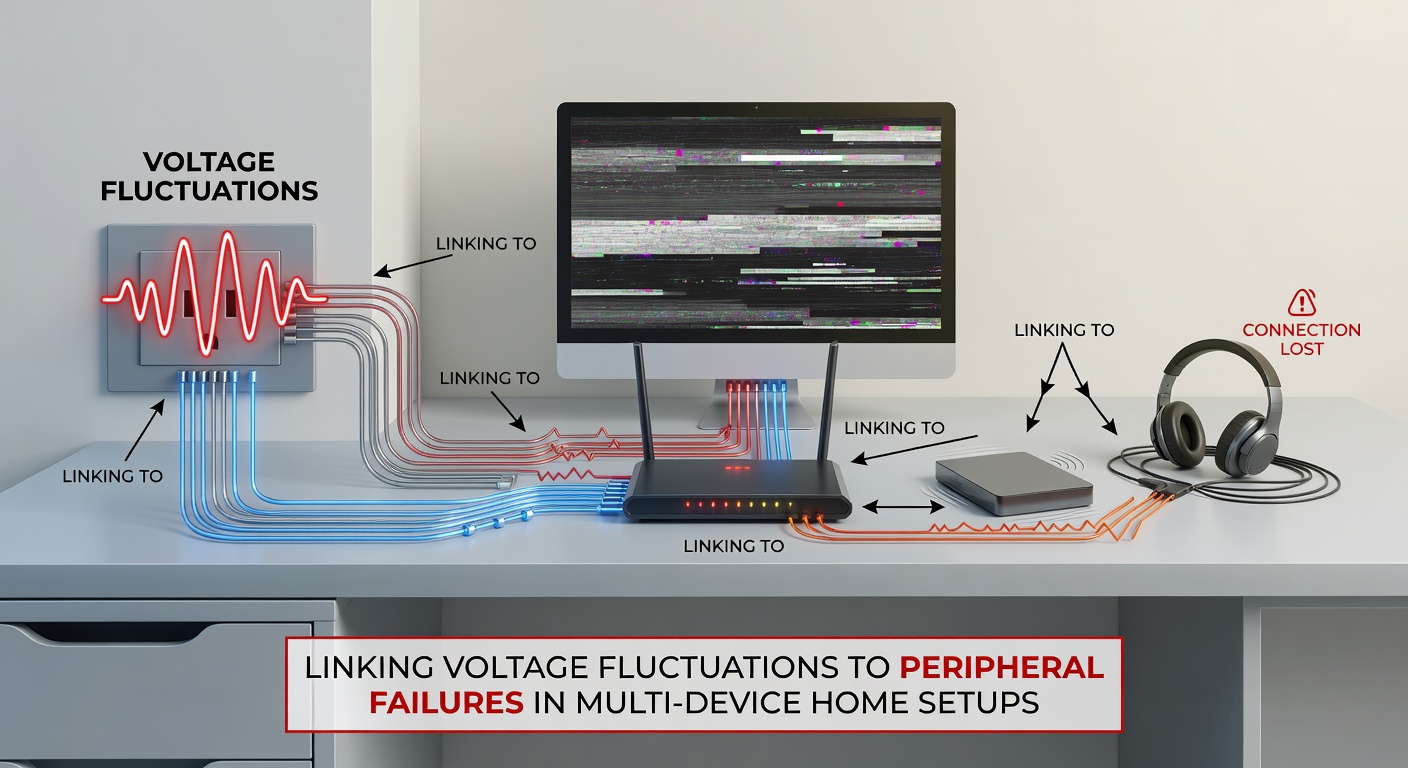
Linking Voltage Fluctuations to Peripheral Failures in Multi-Device Home Setups
Multi-device households often experience unexpected peripheral malfunctions that trace back to inconsistent power delivery rather than hardware defects or software conflicts; voltage fluctuations occur when electrical supply deviates from standard levels and these variations disrupt the operation of external drives, printers, scanners, and network-attached storage units connected through shared outlets or power strips. Observers note that homes with five or more active peripherals show higher rates of intermittent failures because each additional device draws current that compounds existing instability in the local circuit.
Understanding Voltage Fluctuations in Residential Circuits
Residential wiring delivers alternating current that should remain near 120 volts in North American systems or 230 volts in European and Australian installations, yet daily appliance cycles create sags when motors start and surges when loads disconnect. Research from the U.S. Department of Energy indicates that these events happen multiple times each day in typical neighborhoods, and data collected through smart meters reveals that fluctuations lasting longer than a few milliseconds can reset microcontrollers inside peripherals without triggering whole-home breakers. Those who monitor power quality with inexpensive loggers frequently record deviations between 105 and 130 volts during peak evening hours when air conditioners, ovens, and entertainment systems operate simultaneously.
Peripheral devices contain sensitive power supplies that convert incoming AC to lower DC voltages for logic boards and motors; when input voltage drops below design thresholds, capacitors discharge unevenly and firmware encounters errors that manifest as lost connections or failed print jobs. Conversely, brief overvoltages stress voltage regulators and can degrade electrolytic components over months of repeated exposure. Because many peripherals share power strips rather than dedicated circuits, a single voltage event can affect several units at once, creating the appearance of widespread failure when the root cause remains electrical supply.
Observed Patterns in Multi-Device Environments
Technicians who service distributed home workspaces report that external hard drives and wireless routers often fail first during summer months when overall grid demand rises, while laser printers and document scanners show errors later in the same cycle. In one documented instance, a household in a suburban development experienced repeated USB drive disconnections every evening until measurements confirmed voltage sags coinciding with the activation of a neighboring heat pump. The pattern repeated across several addresses on the same transformer, confirming that shared infrastructure rather than individual device faults was responsible.
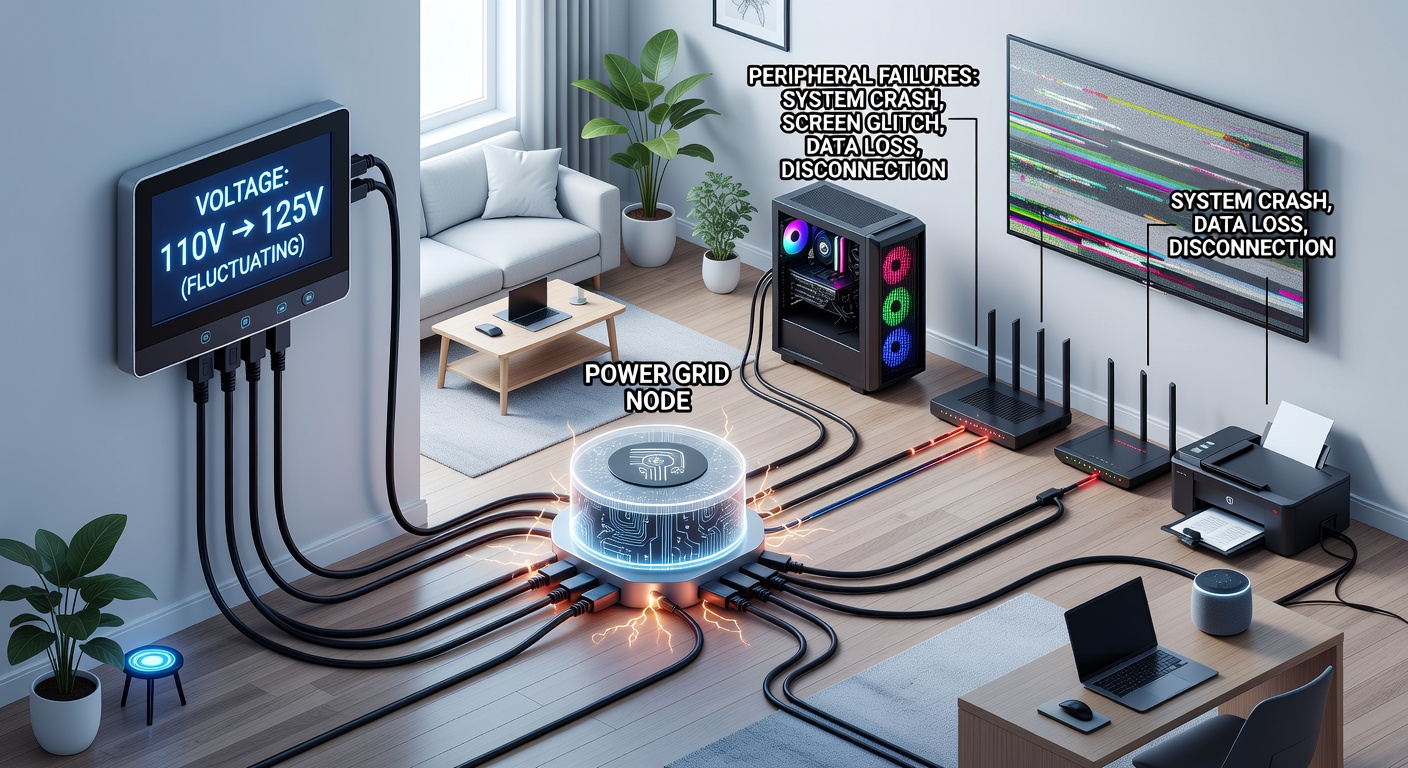
Studies compiled by the European Commission's energy monitoring programs show similar correlations in multi-apartment buildings where common electrical risers serve numerous households; peripheral failure logs peak during periods of high collective consumption and drop when residents install dedicated circuits or voltage regulators. These findings align with observations from Canadian utility reports that track power quality complaints alongside service calls for consumer electronics.
Diagnostic Approaches and Measurement Practices
Accurate diagnosis begins with isolating whether failures follow a time-of-day pattern or coincide with specific appliance usage. Observers recommend logging voltage at the outlet serving the affected peripherals for at least seventy-two hours using devices that record minimum, maximum, and average values at one-second intervals. When logs reveal excursions beyond plus or minus five percent of nominal voltage, attention shifts to panel load balancing or the installation of uninterruptible power supplies rated for the combined draw of connected equipment. Technicians further advise checking that power strips and extension cords meet the amperage requirements of the peripherals because undersized conductors introduce additional voltage drop under load.
June 2026 saw several utilities release updated power quality dashboards that allow homeowners to compare their neighborhood data against historical averages, providing context for whether local fluctuations exceed typical ranges. Such tools help distinguish between normal grid variation and issues stemming from aging transformers or overloaded neighborhood feeders.
Practical Steps That Address Root Causes
Households that separate high-draw appliances onto dedicated circuits often record fewer peripheral incidents, according to field data gathered by electrical contractors. Adding a whole-home surge protective device at the service panel reduces the amplitude of transient spikes, while point-of-use uninterruptible power supplies with automatic voltage regulation handle both sags and swells for individual peripherals. Regular inspection of outlet wiring and replacement of aluminum branch circuits with copper where permitted by local codes further stabilizes delivered voltage. Manufacturers of network-attached storage units increasingly include internal capacitors sized to ride through short fluctuations, yet these features cannot compensate for sustained deviations beyond equipment specifications.
Conclusion
Voltage fluctuations represent a measurable and addressable factor in peripheral reliability within multi-device homes, and systematic logging combined with targeted electrical improvements consistently reduces failure rates across documented cases. Continued monitoring through utility dashboards and consumer-grade power quality tools enables residents to identify patterns early and apply corrections before cumulative component stress leads to permanent damage.