Patterns of Interference in Wireless Setups During Simultaneous Security Updates Across Multiple Platforms
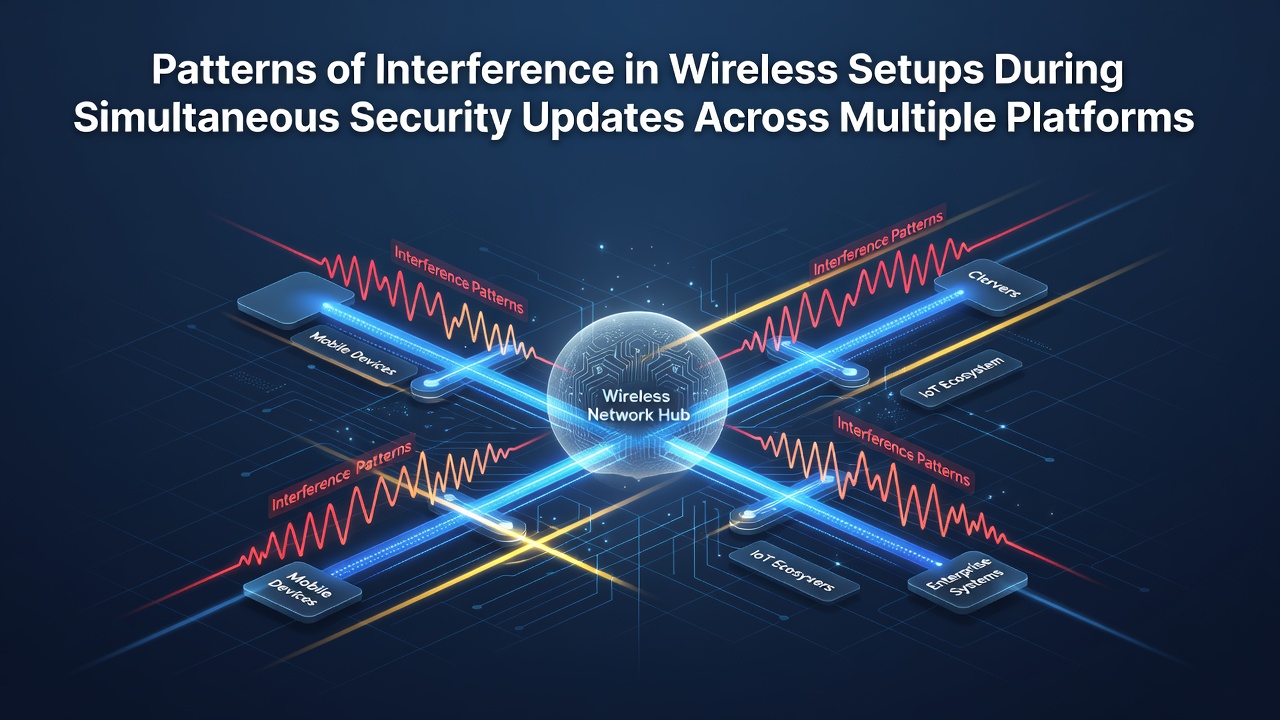
Wireless networks encounter distinct interference patterns when security updates roll out simultaneously across multiple platforms, and those patterns emerge from the combined effects of high-bandwidth downloads, repeated authentication handshakes, and overlapping radio signals in the 2.4 GHz and 5 GHz bands. Data collected from enterprise monitoring tools shows packet loss rates climbing above 18 percent in environments where more than twelve devices initiate updates within a five-minute window, while latency spikes often exceed 250 milliseconds on shared access points.
Bandwidth Saturation and Channel Contention
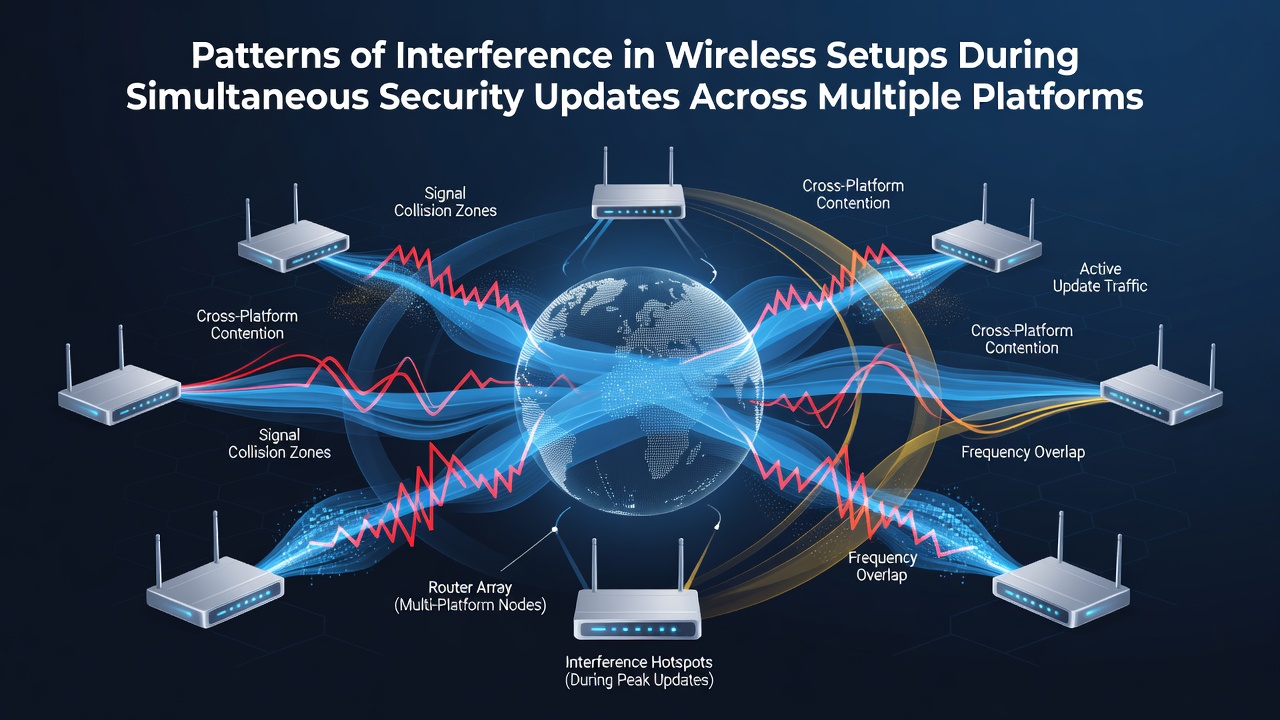
Security patches for operating systems such as Windows, macOS, iOS, and Android frequently range between 150 MB and 800 MB each, so concurrent transfers quickly consume available airtime on a single channel. Researchers at the University of Melbourne documented channel utilization rates surpassing 85 percent during synchronized update events, and those measurements revealed that devices on the same SSID compete for transmit opportunities using CSMA/CA backoff algorithms that extend contention windows from 15 slots to more than 1023 slots. The resulting retransmissions generate additional management frames that further crowd the medium and create secondary interference for neighboring networks operating on adjacent channels.
Device Heterogeneity and Protocol Differences
Platforms implement update mechanisms differently, and those differences produce measurable interference signatures. Android devices tend to open multiple parallel HTTPS connections that fragment airtime into short bursts, whereas iOS devices maintain longer TCP sessions that occupy a channel for extended periods. Windows endpoints often schedule background delivery optimization traffic that uses multicast DNS queries, and those queries collide with the unicast acknowledgment frames required by macOS clients. Observers note that mixed-platform households experience the strongest interference peaks between 02:00 and 04:00 local time when automated update policies activate without user intervention.
Observed Patterns in July 2026 Field Data
During July 2026, a coordinated security push for a widely deployed mobile operating system coincided with a major desktop patch cycle, and network operators recorded characteristic interference sequences across residential and small-office deployments. The first phase showed a sharp rise in beacon frame collisions within the first ninety seconds, followed by a secondary wave of RTS/CTS exchange failures as client devices attempted to reserve airtime. Signal-to-noise ratios dropped an average of 7 dB on channels 1, 6, and 11 in the 2.4 GHz band, while 5 GHz DFS channels experienced radar false positives triggered by the dense pulse patterns of update traffic. Australian Communications and Media Authority spectrum reports from that period confirmed elevated duty cycles in metropolitan areas where multiple households ran simultaneous updates on overlapping routers.
Mitigation Techniques Employed by Network Administrators
Network administrators address these patterns through channel planning that separates high-density update traffic onto non-overlapping 5 GHz channels, and they apply client steering policies that direct newer devices to 6 GHz where available. Quality-of-service rules that prioritize acknowledgment frames over bulk transfer packets reduce retransmission storms, while scheduled update windows staggered by platform type prevent simultaneous saturation. Firmware updates released in mid-2026 for several consumer router models introduced explicit support for 802.11ax target wake time features that allow clients to negotiate transmission slots and thereby lower collision probability during large patch distributions.
Measurement Tools and Metrics
Continuous spectrum analysis using tools such as Wireshark with 802.11 radio tap headers, or dedicated Wi-Fi analyzers from vendors including Ekahau and MetaGeek, captures the precise timing of interference events. Key metrics include retry rate, average contention window size, and airtime fairness index, and these values correlate strongly with the number of devices executing security updates within a rolling fifteen-minute interval. Research published by the IEEE Communications Society indicates that retry rates above 12 percent reliably predict user-perceived application stalls even when raw throughput remains above 50 Mbps.
Conclusion
Patterns of interference during simultaneous security updates follow predictable sequences driven by bandwidth demand, protocol variations, and radio resource contention, and network operators who monitor these sequences can apply targeted configuration changes that preserve connectivity stability across heterogeneous device fleets. Continued refinement of scheduling algorithms and adoption of newer Wi-Fi standards continue to reduce the severity of these events in both residential and enterprise environments.