The Influence of Household Appliance Interference on Wireless Signal Integrity in Multi-Story Residences
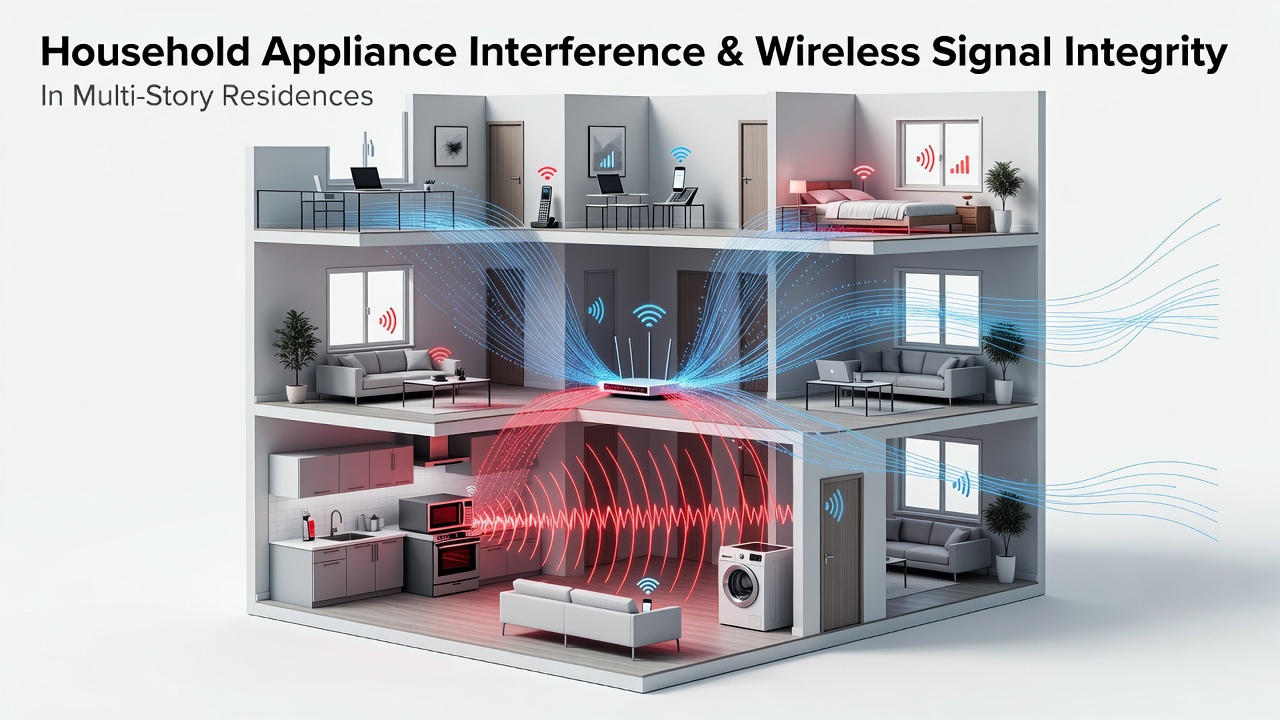
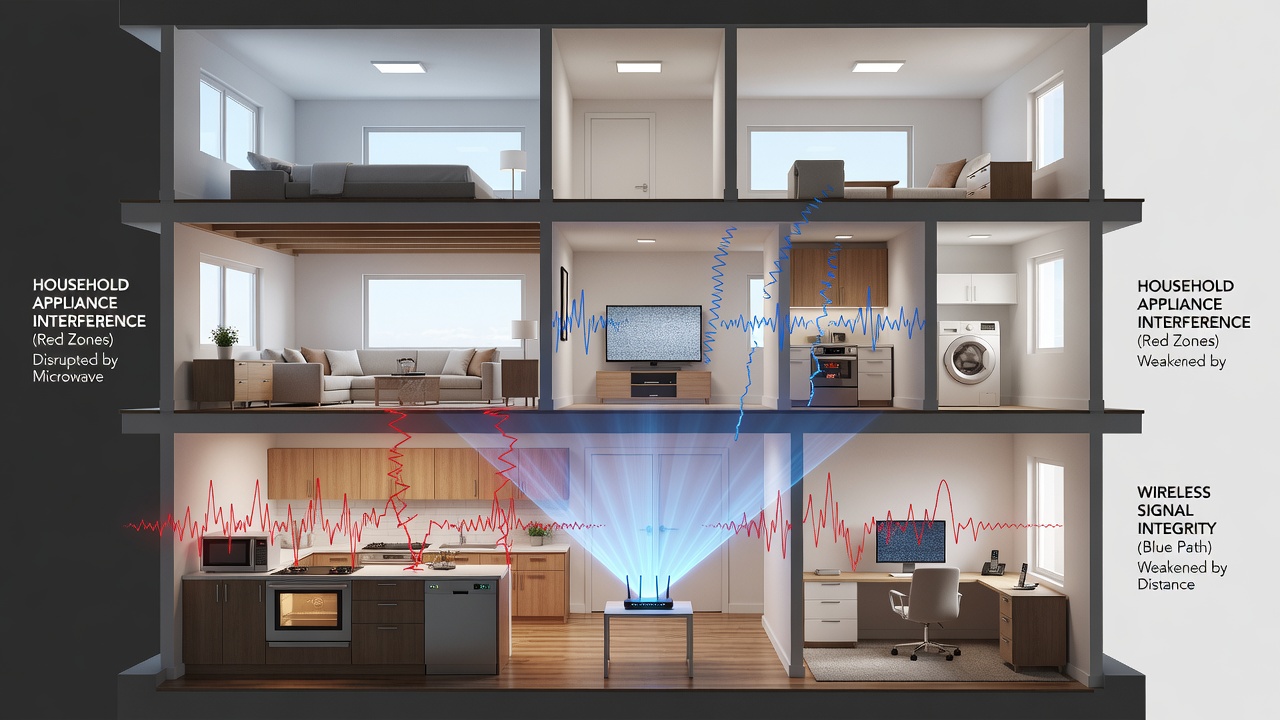
Household appliances generate electromagnetic fields that overlap with the frequency bands used by wireless networks, and this overlap becomes particularly noticeable in multi-story residences where signals must travel through floors, walls, and ceilings. Microwave ovens, cordless phones, baby monitors, and certain types of LED lighting operate in or near the 2.4 GHz spectrum that many Wi-Fi routers still rely on, creating pockets of reduced throughput and increased latency for devices on different levels. Data collected by network monitoring tools shows that signal strength can drop by 30 to 50 percent when a microwave runs on the floor directly below a router, while cordless phone handsets left charging near access points produce steady background noise that fragments packet delivery.
Frequency Overlap and Appliance Behavior
Most residential routers default to channels within the 2.4 GHz band because of its longer range, yet this same band accommodates microwave magnetrons, older DECT cordless phones, and Bluetooth devices that transmit in short bursts. When an appliance activates, its emissions raise the noise floor across several adjacent channels, forcing the router to either reduce data rates or switch channels mid-session. Researchers at the University of Melbourne documented similar patterns in 2024 tests where a single microwave reduced neighboring 2.4 GHz throughput from 120 Mbps to under 25 Mbps for the duration of its cycle. Five-gigahertz networks experience less direct overlap, but they suffer from shorter range and greater attenuation when passing through concrete slabs, so many homes continue to depend on the lower band for whole-house coverage.
Vertical Signal Propagation Challenges
In single-story homes the interference remains localized, whereas multi-story layouts allow emissions from one floor to reach routers and clients on others through shared risers, stairwells, and ventilation ducts. A washing machine with a variable-speed motor on the ground floor can radiate broadband noise that travels upward and affects the signal reaching a home office on the third level. Observers note that signal maps produced by apps such as Wi-Fi Analyzer frequently reveal dead zones directly above or below high-power appliances even when the router itself sits in a central location. Floor materials compound the issue: timber joists permit more leakage than poured concrete, yet both allow enough energy through to create measurable interference zones that shift as residents move appliances or change operating schedules.
Measured Impact on Daily Use
Performance logs from managed service providers indicate that video calls and cloud backups experience the highest failure rates during peak appliance usage hours, typically between 6 and 8 p.m. when microwaves, dishwashers, and induction cooktops run simultaneously. Packet-loss rates climb from a baseline of 0.5 percent to more than 8 percent in affected areas, triggering retransmissions that double the time required to sync large files. Automated smart-home devices such as security cameras and thermostats also report intermittent disconnects, because their low-power radios cannot overcome the elevated noise floor created by neighboring appliances. In one documented case, a family in a three-story townhouse traced repeated streaming interruptions to a cordless phone base station placed on the middle floor directly beneath the main router.
Diagnostic Approaches Used by Technicians
Network professionals begin by capturing spectrum data with portable analyzers that display real-time energy across 2.4 GHz and 5 GHz channels. Sustained spikes that coincide with appliance cycles point to interference rather than simple distance or attenuation problems. They then isolate the source by powering appliances on and off while monitoring client signal-to-noise ratios. Once the offending device is identified, technicians often recommend relocating the router to a different vertical position, switching to less crowded channels, or adding access points that operate exclusively on 5 GHz or 6 GHz bands where appliance emissions are weaker. Mesh systems with dedicated backhaul radios further reduce the impact because client devices connect to the nearest node rather than fighting through a single congested path.
Regulatory and Standards Context
The Federal Communications Commission maintains guidelines that limit unintentional emissions from household appliances, yet these limits allow enough leakage to affect nearby receivers operating on shared frequencies. In Canada, Innovation, Science and Economic Development Canada applies similar emission masks and publishes measurement procedures that manufacturers must follow before selling appliances. European standards under ETSI also address electromagnetic compatibility, though enforcement varies by country and appliance category. As of June 2026, ongoing field trials in several metropolitan areas continue to collect data on how newer Wi-Fi 7 devices handle coexistence with legacy appliances that lack modern shielding improvements.
Conclusion
Wireless signal integrity in multi-story residences depends on the interaction between router placement, building materials, and the electromagnetic signatures of everyday appliances. Spectrum overlap remains the primary mechanism, while vertical propagation paths allow interference to reach devices on multiple levels. Measurement campaigns and technician reports consistently demonstrate that targeted channel selection, strategic router positioning, and adoption of higher-frequency bands reduce the effects without requiring appliance replacement. Continued monitoring by regulatory bodies and equipment vendors supplies the data needed to refine both hardware designs and installation practices as residential wireless demands grow.